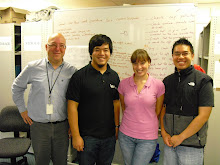
Diana Eng came to Auckland last month to be a part of AUT’s Colab Summer Workshop Series. The workshops allowed Diana to share her ideas with other creative people and inspire them to use new technology. It seems with her collections that she is interested in biomimicry, as I am with my own project. Biomimicry essentially means the imitation of life. For example, look at Eng’s collapsible structures which mimic the pleat pattern structure of a leaf when it blooms.
Watch this Campbell Live item which looks at Eng’s use of conductive thread in her clothing. The clothing also has sensing capabilities. For example, the electro luminescent wire used in a garment lights up and responds to the sound of talking. A skirt lights up when the wearer is walking. It is amazing to see clothing that is sensing the environment around it and responding to it. These garments are an example of smart clothing. Another innovative item Diana Eng actually sells is a smart scarf, called the Jack Frost Scarf. The images of snowflakes develop and become larger when the scarf is exposed to cold temperatures. I remember hyper coloured t shirts from my childhood which seemed to work in reverse. The fabric changed colour when exposed to heat. I loved pressing my warm handprints to the fabric and making other patterns with hot breath or by standing in the sun. They weren't so great though if you had hot underarms!
Eng comments that these items cannot be washed so they fail to meet some requirements we need in our everyday clothing. But that hardly matters. The items are wearable and function to cover the body in a fashionable and innovative way. Are they items of clothing or works of art?
It is inspiring to see another artist/designer collaborating with experts in fields different from their own. We can see what is possible when we come together from different fields and investigate how to combine them.
Right now, my project is really accelerating. I have successfully completed a large artwork (roughly 700 x 700mm). The artwork looks great and I am looking forward to actuating all the elements as soon as possible. I will post some video of the movements once they are working. For now, I have some photos of the static work. I hope you like it.

The artwork viewed from a short distance. The display box is visible to see how the frames are put together.

Close up of the artwork. The artwork is jigsaw puzzle of different frames put together to create the image.